Why Are Mixed Workloads Bad?
April 7, 2014 § Leave a comment
When I started working in storage, I remember reading an IBM recommendation not to mix tape and disk workloads. There wasn’t much of an explanation associated with this statement other than “for performance reasons”. I’m going to use this post to take a look at the interaction of these two workloads?
Let’s assuming we are streaming data to a tape drive at the same time as accessing data in a low request size, low throughput, latency sensitive manner. So, we have workloads feeding into one queue:
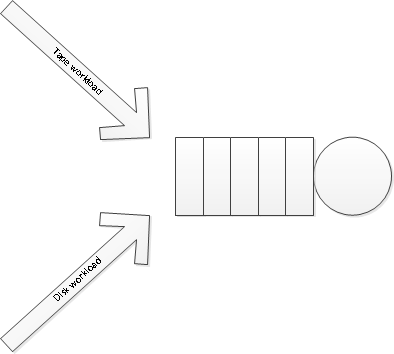
The utilization of the link is dominated by the large request size tape data. Further, when a small request enters the queue, it is the large requests ahead of it that will dominate the queuing time. We can therefore approximate the wait time and the utilization using standard M/M/1 queueing formulae for the large tape requests and then apply that to the small transactional requests.
For large request sizes of 64K, 128K and 256K, we find the response time curve of the 2K workload to be significantly impacted:

 ascknd
Leave a comment